STEPS' scholar-led podcast dives deep into the world of phosphorus sustainability.
PhosForUs Podcast
PhosForUs is a STEPS scholar-led podcast all about phosphorus! In each episode, we reach out to subject matter experts, within and outside STEPS, as we try to understand the challenges and opportunities towards phosphorus sustainability. From interviews and panel discussions with our guests, to discussions about key parts of STEPS, we have it all right here. So put on your headphones, press play, and listen along.
For questions or suggestions related to any of our episodes or our podcast in general, please reach out at [email protected].
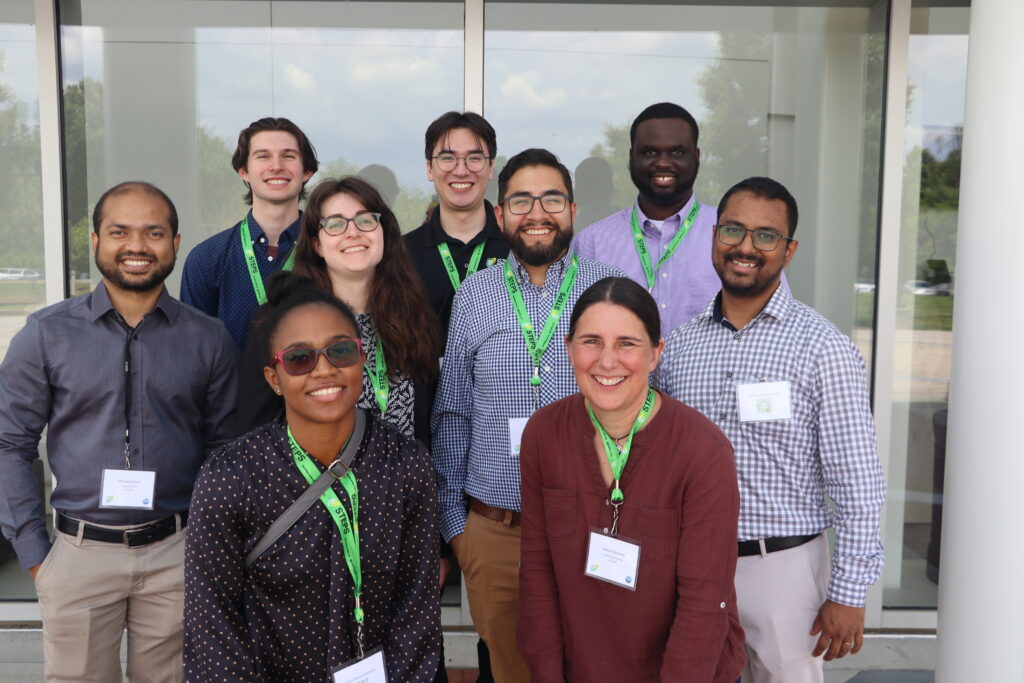
Our podcast team consists of undergraduate, graduate, and postdoctoral scholars in the STEPS Center, each engaged in exciting phosphorus related research in one of the partner institutions. Each episode is a result of our collective hard work.
PhosForUs Episodes
Episode 18: From Watersheds to Washington: How Science Can Shape Smarter Phosphorus Policy
What can watershed science teach us about designing more effective phosphorus policy? In this episode of the PhosForUs Policy Series, host Barira Rashid sits down with her PhD advisor, Dr. Rebecca Muenich, whose research connects watershed modeling, nutrient management, water quality, animal agriculture, and phosphorus sustainability. They discuss what policymakers may overlook when phosphorus is managed one farm, permit, or practice at a time; how legacy phosphorus complicates expectations for water-quality improvement; and why better monitoring is essential for informed decision-making.
Hosted by Barira Rashid.
Episode 17: Phosphorus, Policy, and the Systems That Shape Outcomes
In this episode of PhosForUS, hosts Alison Deviney (Postdoctoral Researcher, STEPS Center) and Barira Rashid (PhD Candidate, University of Arkansas) sit down with Jay Rickabaugh, Assistant Professor of Public Administration at North Carolina State University, to explore the governance side of phosphorus sustainability.
Hosted by Alison Deviney and Barira Rashid.
Episode 16: The Policy Landscape of Phosphorus: Where Agriculture, Conservation, and Water Quality Collide
Hosts Barira Rashid (PhD Candidate, University of Arkansas) and Hector Fajardo (PhD Candidate, NC State University) sit down with Jonathan Coppess, Associate Professor of Agricultural Policy at the University of Illinois Urbana-Champaign, to unpack how phosphorus shows up in U.S. farm policy, from conservation programs and nutrient management plans to the economic pressures farmers face every day.
Hosted by Barira Rashid and Hector Fajardo.
Episode 15: P-Week ’26: STEPS Toward a P-Resilient World
Welcome back to the PhosForUs podcast! We are beginning this season with a special episode, featuring the Managing Director, Maude Cuchiara and the Director, Jacob Jones, reflecting on the vision behind STEPS Center and the meaning of Phosphorus Week. In this conversation, they share personal insights, the evolving role of phosphorus in shaping food systems and policy, and why this moment matters for building a more connected, forward-looking community around phosphorus sustainability.
Hosted by Barira Rashid.
Episode 14: Exploring the Aquatic Triple Bottom Line Scenario in South FL: Science, Community, and Phosphorus Sustainability with Dr. Jehangir Bhadha
The Everglades Agricultural Area in South Florida is the home of the most unique and fertile soils in the country—organic-rich Histosols with over 80% organic matter. These soils, once part of a vast wetland ecosystem, have been drained over the past century to support agriculture, especially sugarcane, rice, and vegetables. But beneath this productivity lies a hidden concern: decades of phosphorus fertilizer use have created a massive reserve of legacy phosphorus.
Hosted by Xue Bai and Anik Mahmud. Music by Lucas Crane.
Episode 13: Phosphorus Fertilization Insights from the Agricultural Triple Bottom Line Scenario Site in Eastern NC, with Dr. Luke Gatiboni
In this episode, Dr. Luke Gatiboni, professor and extension specialist in the Soil and Crop Sciences Department at NC State, shares insights from his research on phosphorus management. The story of phosphorus fertilization in Eastern North Carolina unfolds, beginning with the region’s unique coastal soils and the historical build up of legacy phosphorus from decades of agricultural use. The episode highlights the Tidewater Research Station, a key site for long-term fertilization experiments that have helped shape current understanding of phosphorus dynamics in crop production. From past practices to present-day challenges, the discussion dives into how researchers are managing phosphorus for both productivity and environmental sustainability in one of the state’s most important agricultural regions.
Hosted by Jiangfeng Xu and Hector Fajardo. Music by Lucas Crane.
Episode 12: P, People, and Pets? Phosphorus Dynamics in the Urban Triple Bottom Line Scenario Site in Phoenix, AZ
Phosphorus dynamics within any system can be complex, but none are more complex than urban systems. The STEPS Center has established one of its key Triple Bottom Line (TBL) scenario sites as the Central Arizona–Phoenix Long Term Ecological Research (CAP-LTER) site, which considers the unique dynamics between the urban metropolis of Phoenix and its peri-urban, rural, and environmental surroundings. In this episode of PhosForUs, we chat about phosphorus dynamics in urban settings, including recovering phosphorus from urban waste streams, modeling of phosphorus flows within urban scenarios, and identifying future trends in engineering, technology, and regulation that can drive phosphorus dynamics.
Hosted by Lucas Crane, Maheen Mahmood, and Minhazul Islam.
Episode 11: Beyond the Flush: Rethinking Toilets for Phosphorus Recovery
Bathrooms are in nearly every building and the infrastructure has not changed much. But what if bathroom infrastructure changed the way phosphorus was recovered? In this episode we take a long term view on the future of urine diversion technology and its place in modern buildings.
Hosted by Josephine Geraghty.
Episode 10: Exploring Triple Bottom Line Scenario Sites: Pathways to Convergence Research
The STEPS Center uses tools called boundary objects to help build convergence capacity – that is, the ability to effectively co-create new knowledge – across its multidisciplinary research community. This episode is an introduction to one of those boundary objects, the Triple Bottom Line Scenario Site, also known as TBL Sites.
Hosted by Smitom Borah and Alison Deviney.
Episode 9: Bridging Research and Practice: An interview with Dr. Deanna Osmond
In this episode, we interviewed Dr. Deanna Osmond, professor in the Soil and Crop Sciences Department at North Carolina State University. We explore Dr. Osmond’s career in nutrient management, focusing on the challenges of phosphorus sustainability in agriculture.
Hosted by Lily Kyle and Hector Fajardo.
Episode 8: A P(ee) Research Update—Urine Diversion for P Sustainability
What if I told you that your urine can be a potential solution for the world’s phosphorus conundrum? In this episode, we discuss how urine can be a resource instead of a waste and chat about two upcoming peer-reviewed articles based on STEPS research.
Hosted by Ashton Merck and Lucas Crane.
Episode 7: Phosphorus Week
Phosphorus Week 2024 is a special occasion celebrated by the Science and Technologies for Phosphorus Sustainability (STEPS) Center and the Sustainable Phosphorus Alliance (the Alliance). In this episode, we reach out to Dr. Matthew Scholz to know more about Phosphorus Week and how we can contribute towards phosphorus sustainability.
Hosted by Hector Fajardo.
Episode 6: What and Why: Convergence Research
Modern challenges of today create the need for more efficient and effective research to tackle them. By what means are we achieving this? Convergence research is how. In this episode, we want to elaborate on the fine details of convergence research.
Hosted by Alison Deviney and George Hotelling.
Episode 5: Introduction to the P Flow Diagram
The P flow diagram is a key aspect of STEPS convergence research, because it functions as a “boundary object” to connect researchers from many different fields. In this episode, we give a brief overview of what flow diagrams are, and then we talk to some of the researchers in STEPS about how they use the P flow diagram and what they like (and don’t like!) about it.
Hosted by Ashton Merck.
Episode 4: Who Are the Guardians? A Conversation with Dr. Dana Cordell
As much as we need food to stay alive, our crops need phosphorus to keep growing. But how do we ensure a sustainable phosphorus supply to our agricultural lands? In fact, who ensures that sustainability? Who are the other stakeholders? Hear from Dr. Dana Cordell, Research Director of the Food Systems research group at the Institute of Sustainable Futures, University of Technology Sydney, Australia.
Hosted by Dr. Jacob Jones, Director of STEPS.
Episode 3: Phosphorus and Climate Crisis: Why Should We Care?
Phosphorus is a key element for life on Earth, but it can also have devastating effects on the environment when it accumulates in water bodies. In this episode, we explore the complex relationship between phosphorus and climate change, and how it affects the health of ecosystems.
Hosted by: Smitom Borah.
Episode 2: STEPS Vision: Is 25-in-25 Possible?
The Science and Technology for Phosphorus Sustainability (STEPS) center is a recently created convergence research center that is addressing the complex challenges around phosphorus sustainability with an interdisciplinary group of researchers coming from diverse scientific areas. In this episode, we talk to the director of the STEPS center, Dr. Jacob Jones, about the 25-in-25 vision of the center.
Hosted by: Hector Fajardo and George Hotelling.
Episode 1: Phosphorus: Past, Present, and Future
Phosphorus is an important element on earth. It is a non-metallic element that is essential for life as we know it. It is used in a variety of industrial and agricultural applications, such as fertilizers, food additives, and flame retardants. However, excess phosphorus usage has also led to many environmental problems. In this episode, we talk to two renown phosphorus experts, Dr. Jim Elser and Dr. Phil Haygarth, about Phosphorus’s past, present, and future.